A Reflection on Psalm 88 and the Silence of God
There are moments in life when faith does not feel triumphant. It feels like standing alone at the edge of something vast and terrible, staring into the depths and wondering if God is still there.
Unlike most psalms, this one contains no resolution, no triumphant ending, no sudden burst of hope. It is a prayer written by someone who feels as if they are standing at the edge of a spiritual chasm.
The psalmist writes:
“For my soul is full of troubles,
and my life draws near to Sheol.
I am counted among those who go down to the pit.”
— Psalm 88:3–4 (ESV)
The Hebrew word Sheol refers to the realm of the dead, the shadowy place beneath life where hope seems extinguished. The “pit” described throughout the psalm was a powerful metaphor in the ancient world: a deep cistern, a dungeon, or a grave.
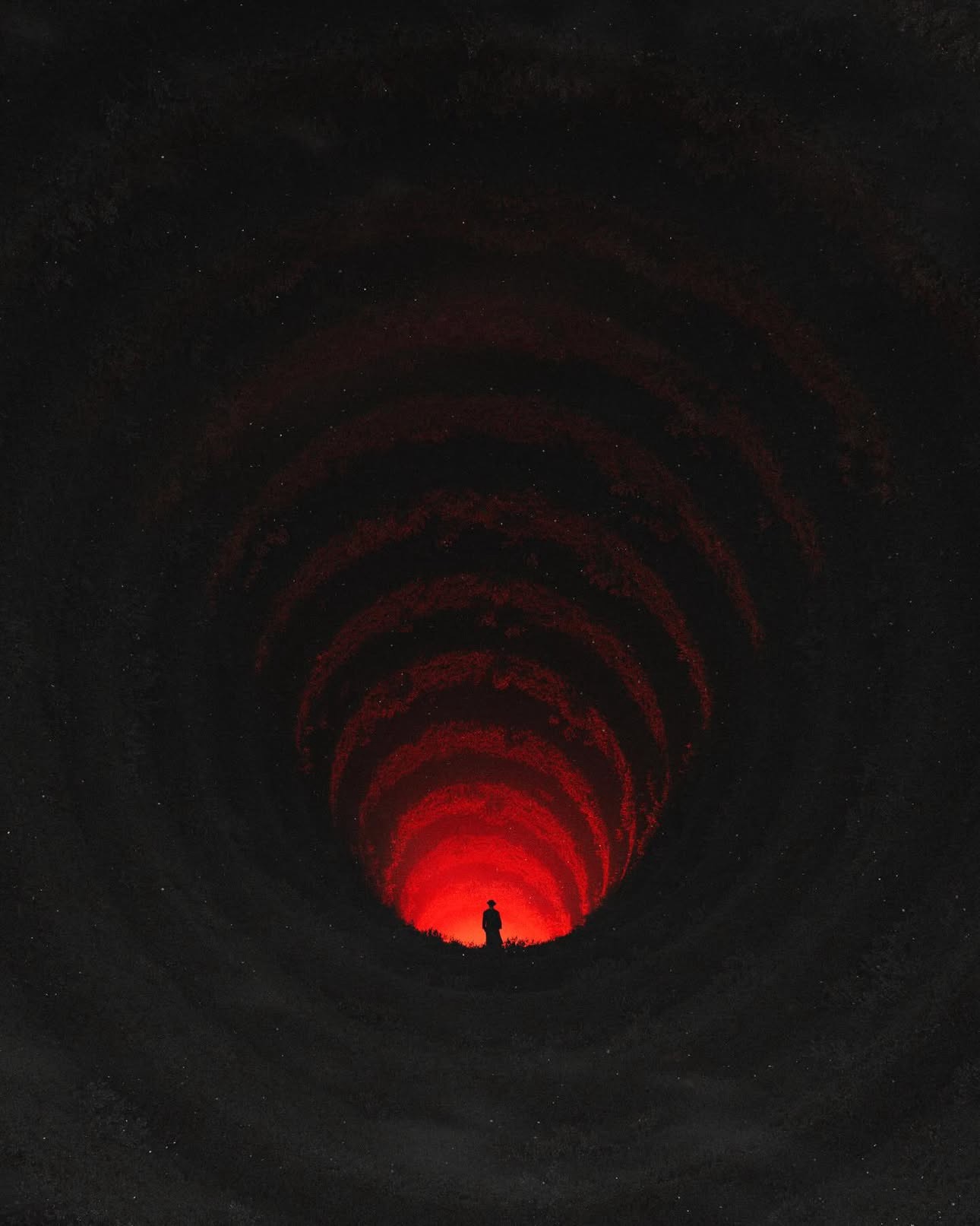
The spiral abyss in the image resembles exactly that biblical idea: a descent into the depths where light fades and the world above feels impossibly distant.
The Experience of Divine Silence
Psalm 88 is unique because it does not resolve the tension between suffering and faith. Instead, it confronts the terrifying possibility that God may seem silent.
The psalmist continues:
“You have put me in the depths of the pit,
in the regions dark and deep.
Your wrath lies heavy upon me.”
— Psalm 88:6–7
Standing before the red-lit void in the image, the figure could easily represent this moment—when a person feels that they have been placed in darkness, abandoned to suffering, or left to face something overwhelming alone.
But what is remarkable about Psalm 88 is not its despair.
It is that the prayer continues at all.
Even when the psalmist believes he is in the pit, he keeps speaking to God.
Faith at the Edge of Darkness
This is one of the Bible’s most profound teachings about faith: true faith does not only exist in moments of victory.
Sometimes faith looks like a lone figure standing at the edge of the abyss and still calling out to God.
The psalmist writes:
“But I, O Lord, cry to you;
in the morning my prayer comes before you.”
— Psalm 88:13
There is no miracle yet.
No rescue yet.
No explanation yet.
But the prayer continues.
That is faith.
The man in the image is not falling into the spiral.
He is standing before it.
That distinction matters.
The Biblical Pattern: Descent Before Redemption
Throughout Scripture, the journey into darkness often precedes transformation.
Joseph was thrown into a pit before rising to power in Egypt.
Jonah descended into the depths of the sea before being delivered.
Job sat in ashes before encountering the voice of God.
Even Christ himself descended into death before resurrection.
The pattern repeats again and again:
Descent → Waiting → Redemption
The image captures that moment between descent and redemption, the terrifying pause where the outcome is unknown.
The Furnace That Refines
The fiery glow in the spiral also evokes another powerful biblical image: the refining furnace.
In the book of Malachi, God describes suffering as a process that purifies rather than destroys:
“For he is like a refiner’s fire…
and he will purify the sons of Levi and refine them like gold and silver.”
— Malachi 3:2–3
Fire in Scripture is not only judgment.
It is purification.
Gold is not destroyed in the furnace, it is made pure.
The spiral in the image could represent that process: the terrifying but necessary heat that strips away what cannot endure.
Why Psalm 88 Matters
Psalm 88 ends with one of the most unsettling lines in the Bible:
“Darkness is my closest friend.”
— Psalm 88:18
There is no resolution.
And yet this psalm was preserved in Scripture for thousands of years.
Why?
Because God did not silence this prayer.
God allowed it to remain in the Bible as a witness to something deeply human: that even in darkness, even when hope seems absent, the act of turning toward God still matters.
At the threshold.
Between light and darkness.
Between faith and despair.
Between the known world and the depths.
And yet he stands upright.
He has not fallen.
He has not turned away.
He simply stands and looks into the abyss.
In many ways, that posture itself is a form of prayer.
The Quiet Promise Beneath the Darkness
The Bible never promises that believers will avoid the pit.
But it repeatedly promises something else:
No pit is deeper than God’s reach.
Another psalm declares:
“If I make my bed in Sheol, you are there.”
— Psalm 139:8
Even the deepest spiral of darkness cannot place someone beyond the presence of God.
Not the grave.
Not despair.
Not suffering.
Not silence.
The man in the image may believe he stands alone.
But Scripture insists he does not.
The Final Reflection
The image captures a moment many believers experience but rarely discuss: the terrifying silence between prayer and answer.
It is the place where faith stops being theoretical and becomes existential.
Where belief is no longer about certainty, but about continuing to stand.
Standing at the edge.
Looking into the depths.
And still whispering, like the psalmist:
“O Lord, I cry to you.”
Even there.
Especially there.